
As people pursue better lives and the technological innovations continuously advance, the choice of building materials has become increasingly diverse. However, natural materials continue to be popular among those seeking high-quality lifestyles due to their eco-friendly properties.
Traditionally, wood flooring has been a favored material, but in recent years, bamboo flooring has gained popularity as a modern construction material and is increasingly valued.
In this article, we will discuss the pros and cons of bamboo flooring. And if you want to know our bamboo flooring products, just click Solid Bamboo Timber Flooring to know more details.
Advantages of Bamboo
Bamboo is a grass that grows from roots. Most bamboo species mature within 3-5 years and are highly renewable.
Bamboo is strong and hard, primarily due to its structural properties. Bamboo grows quickly, has long fibers, and possesses high tensile and compressive strength, resulting in bamboo products with high strength and hardness. This makes bamboo boards widely used in construction, furniture, and other fields, meeting requirements requiring high load-bearing capacity.
Bamboo’s solid texture and clear grain create a striking visual effect. Its fiber structure imparts a smooth and glossy surface, and its color and grain are highly aesthetic, making it widely used in interior decoration and furniture manufacturing.
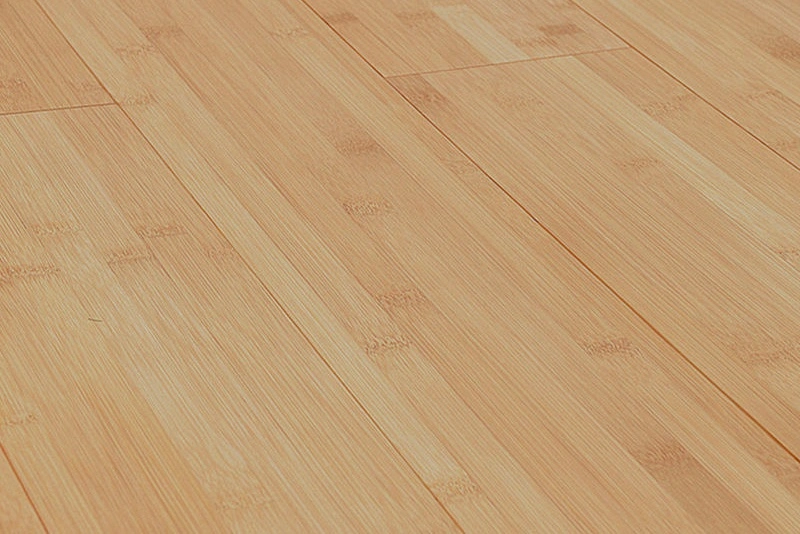
Horizontal bamboo flooring |
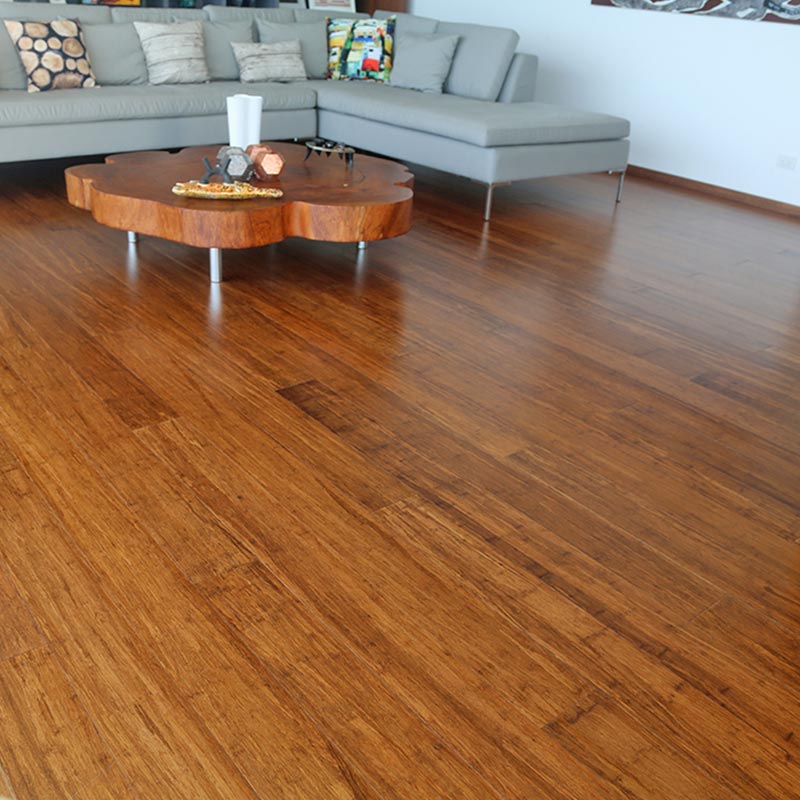
Strand Woven Bamboo flooring |

Vertical bamboo flooring |
Advantages of Bamboo Flooring
First off, it’s eco-friendly. Bamboo is a herbaceous plant and a renewable resource—it only takes three to five years to mature. Definitely a green, environmentally friendly material.
It’s also pretty dense. Solid bamboo has a density of up to 0.7g/cm³, and strand woven bamboo goes up to 1.3g/cm³.
What’s more, it’s tough and durable. Bamboo has a hardness of at least 2.5N/mm², harder than regular wood. The surface is super scratch-resistant, so the bamboo flooring really holds up well.
It’s got good flexibility too. Bamboo’s bending strength is 111N/mm², and its elastic modulus is 13490N/mm²—both better than regular wood.
It’s strong under pressure too, with a compressive strength of 70.9N/mm², so it handles weight really well.
Stability-wise, it’s reliable. During production, they use processes like steaming, drying, curing, and carbonization to control moisture. That means the bamboo flooring doesn’t shrink or expand much, and it’s not easy to warp or crack.
Looks-wise, it’s naturally beautiful. It keeps bamboo’s original texture, with a fresh color. You can choose the natural shade or a darker carbonized one. The style is natural and elegant, and it goes with all kinds of decor.
The feel underfoot is nice too. It doesn’t conduct heat quickly, so it’s not cold in winter or hot in summer. It feels warm and smooth to the touch—perfect for home use.
Carbonized Strand Woven Bamboo Flooring
Disadvantages of bamboo flooring:
Frankly speaking, bamboo flooring does have some drawbacks. Let’s discuss them below:
It’s a high-grade product with a slightly higher price: Compared with wooden flooring, the production process of bamboo flooring is a bit more complex, which increases the production cost. The market price of bamboo flooring is 15%-30% higher than that of ordinary solid wood flooring or laminate flooring.
High installation requirements: Bamboo flooring needs to have expansion joints left during installation; otherwise, it’s prone to making abnormal noises or deforming due to thermal expansion and contraction.
Difficult to repair: Like ordinary solid wood flooring, bamboo flooring also has the problem that surface scratches or local damages are hard to repair. In severe cases, the entire piece of bamboo flooring needs to be replaced.
Single texture: Compared with solid wood flooring, bamboo flooring has more regular textures and less natural variation. Its style tends to be modern and simple, with a weaker sense of traditional solid wood texture.
Choose the one suitable for you!
Therefore, the key point is to understand the characteristics of various bamboo flooring types and select the product most suitable for your needs.